
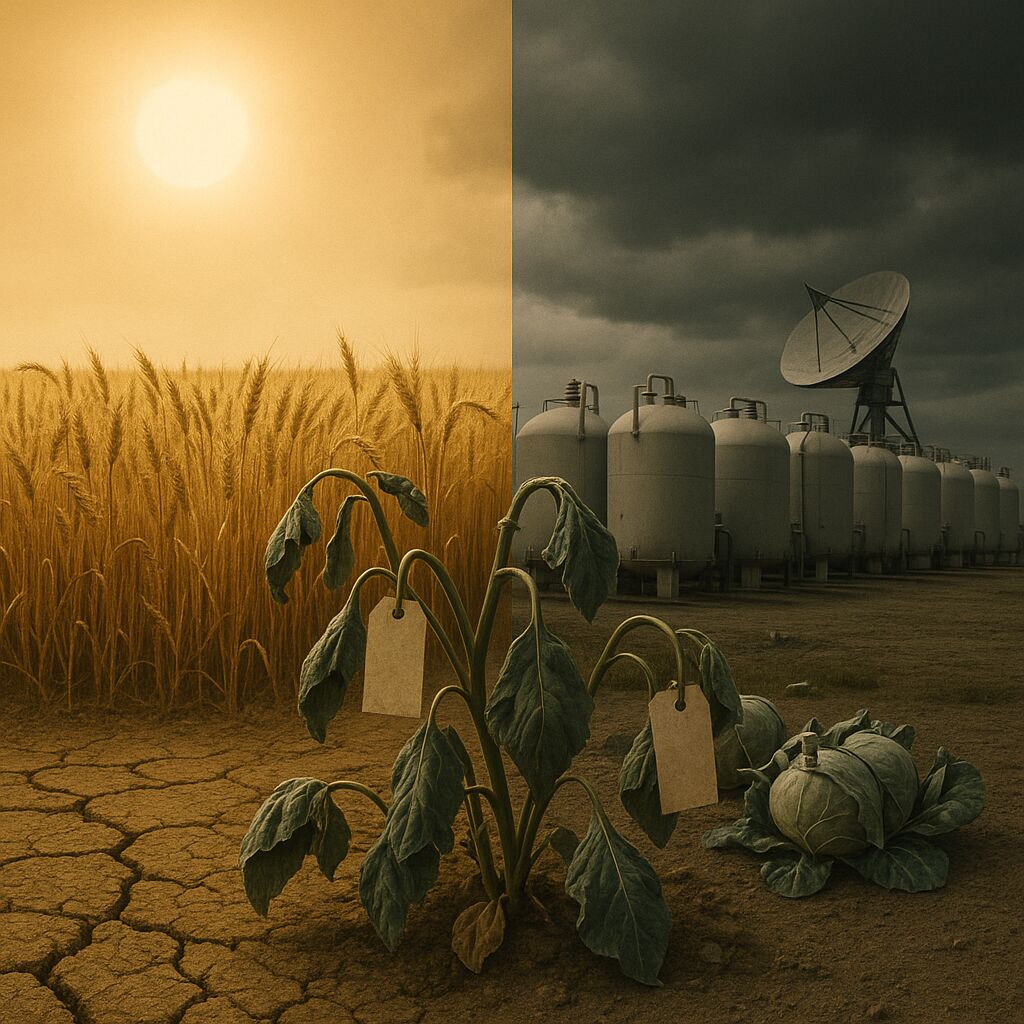
2. Food Security
Risk level: High - June 2026
This is Part 2 of a 13-part series: What a UK Government Should Actually Do.
Read Part 1: Situation Assessment Read The Food Price Crisis: What's Already Built In Read Food Prices: What Actually Happens Next
The food security problem is no longer a debate point. It is not a niche concern for farmers or preppers. It is a structural vulnerability that has been exposed by the triple compound of fertiliser shock, El Nino, and supply chain disruption. In the central scenario - assuming current LNG market disruption persists and the 2027 Northern Hemisphere harvest comes in below trend - the food price peak arrives in 2027. The window for prevention is not yet closed, but it is narrowing fast. What happens in the next six months determines whether the UK faces this as a managed hardship or a supply crisis. This is a conditional projection, not a certainty; the peak could be earlier if Hormuz disruption worsens, or mitigated if alternative supply routes materialise.
This post is about what policy should actually look like. Not the platitudes. Not the press releases. The specific, sequenced actions that would make a meaningful difference, and the honest trade-offs that come with each of them.
Immediate Actions: Now Through End of 2026
The priority here is damage containment. The harvest is already planted. What happens between now and harvest determines what arrives in the autumn. The tools available are blunt, but they matter.
Strategic Grain Reserves
The UK currently holds negligible strategic grain reserves. This is a policy choice that made sense in a world of stable global supply chains and cheap food. That world no longer exists.
The immediate action is a government-funded grain procurement programme, targeting 2 to 3 months of domestic wheat consumption held in reserve. This is not complicated to understand. It is complicated to execute logistically. The grain exists. The storage infrastructure exists, largely underutilised on farms and at merchant sites. What is missing is the purchasing agent and the willingness to pay.
Cost estimate: at current wheat prices, covering 2 months of UK consumption (roughly 1.2 million tonnes) runs to somewhere between GBP 300 million and GBP 400 million in acquisition cost. Storage and management adds perhaps 15 to 20% annually. This is not a small sum, but it is small relative to the cost of a supply shock.
The honest problem with reserves is that they require active management or they cease to be reserves. Wheat stored for more than two to three years degrades for human consumption, becoming suitable only for animal feed at progressively lower market values. A reserve that is not systematically refreshed is a reserve that will not be there when needed. Any programme needs a specific management structure: the reserve should be held under a nominated government agency or contracted commercial manager with a statutory obligation to maintain minimum tonnage (target: 2.5 months of UK domestic consumption, approximately 1.5 million tonnes of wheat equivalent), to rotate a minimum of 15–20% of stock annually through disposal and repurchase to prevent age degradation, and to dispose of stock when market prices fall below a defined trigger level while simultaneously replenishing when prices are elevated. The trigger for disposal should be set as a fixed-band price ceiling: when the market price falls below the trigger for two consecutive months, the manager sells reserved grain into the market to prevent waste, using the proceeds to rebuild stocks when prices normalise. The trigger for replacement is symmetric: when the market price is above the trigger, government purchases to maintain the reserve at target tonnage. The budget for storage, management, and refresh operations should be appropriated separately from the acquisition cost - estimated at £40–60 million annually on top of any acquisition or disposal costs - and subject to an annual audit published alongside the reserve tonnage report. This is not a new instrument; it is the operationally specific version of what a credible strategic reserve programme requires. Without these specifics, a reserve commitment is a headline, not a policy.
Fertilisers Subsidy Restructuring
The current subsidy environment for fertilisers is a blunt transfer that largely flows to input manufacturers and distributors rather than to the farmers who need to apply product. The existing basic payment structure does not distinguish between a farmer applying fertiliser efficiently and one applying it wastefully. It does not respond to price shocks.
The immediate reform is a nitrogen efficiency payment: a per-tonne rebate paid directly to farmers who can demonstrate compliant application, targeted at reducing the cost gap between current prices and the 2024 baseline. This is more efficient than a flat subsidy because it rewards application efficiency, not just volume purchasing.
More importantly, it needs to be combined with a price monitoring mechanism that triggers payments automatically when the fertiliser cost index crosses a defined threshold. The current system requires annual budget cycles and political decisions. That timing gap is fatal when prices move fast. What is needed is a rule-based trigger that activates the payment within 30 days of the index crossing the threshold, not within the next fiscal year.
Import Diversification
The UK imports roughly 40% of its food by value. That dependency is not inherently a problem in a stable world. In a disrupted world, it is a significant vulnerability. The immediate action is a supply chain audit and diversification programme focused on the top 20 imported food categories by value.
This is not about onshoring everything. It is about identifying single-source dependencies and reducing them. For example: where the UK currently imports a critical input from a single country or a single supplier, the government should co-finance the cost of qualifying a second supplier, even at a price premium of 8 to 12%. That premium is the insurance cost. It is worth paying.
The mechanism: a government-backed supplier development fund, administered through the devolved agriculture departments, that co-invests in qualifying new suppliers for the categories identified as highest risk. Total cost over 18 months: GBP 50 million to GBP 80 million. This is not large relative to the exposure it reduces.
Free School Meals Expansion
Food security policy is not only about grain markets and supply chains. It is also about who actually eats when food becomes expensive.
The most immediate distributional impact of the coming price peak will be felt by households already spending 30 to 40% of income on food. As prices rise, they reduce quality, then quantity. Children in those households are the most direct victims.
The immediate action is an emergency expansion of free school meals eligibility to all households receiving universal credit, regardless of income threshold. This is a specific, targeted, administratively simple intervention. It reaches children in households that are above the existing means-tested threshold but are spending so much on food that a price spike pushes them into crisis.
The cost: roughly GBP 700 million annually at current pupil numbers, assuming full take-up. The existing infrastructure already exists. The administrative mechanisms already exist. This is not a new system; it is an expansion of an existing one.
Medium-Term Actions: 2027
The medium-term is about production. The 2027 growing season is the next opportunity to change what arrives in the autumn of 2027 and 2028. Decisions made in the first half of 2027 determine that harvest.
Domestic Production Incentives
The primary constraint on UK domestic food production is not land. It is margin. Farmers produce what is profitable, and the math has been poor for arable crops for several years. The fertiliser shock has made it worse. If the incentive structure does not change, farmers will continue to reduce input application, shift to lower-cost crops, or take land out of production entirely.
The medium-term intervention is a guaranteed minimum price scheme for wheat and barley, modelled on the old Common Agricultural Policy intervention price mechanism but with a defined trigger and sunset clause. When the market price falls below the trigger level for two consecutive months, the government buys at trigger price up to a capped volume per farm. This gives farmers the confidence to invest in the 2027 season, knowing that the downside is protected.
The cost depends on the trigger level and market price. If world prices remain elevated, the mechanism never activates. If they collapse, the cost is capped by the per-farm volume limits and the total programme ceiling. This is designed to be self-limiting.
Urea Equivalent Domestic Production Capacity
The UK currently has zero domestic production capacity for urea, the most common solid nitrogen fertiliser. Urea is produced from ammonia and CO2 via a specific synthesis process. The UK has some ammonia production capability - primarily for industrial uses - but ammonia is not the same as urea. The gap between "some ammonia production" and "functional urea production capacity" is significant: ammonia is an intermediate that requires additional processing to become the solid fertiliser that farms actually use. The decline of UK fertiliser production was driven by the logic of global trade efficiency - it was economically rational at the time, it served the interests of farmers who bought fertiliser cheaply, and it reflected a broader assumption that global supply chains would remain open and affordable. That assumption has been invalidated.
The medium-term action is a government-backed feasibility study and, if the numbers support it, a co-investment in domestic urea production capacity. The feedstock is natural gas. The process is Haber-Bosch synthesis. The capital cost is significant: a small-scale plant capable of producing 500,000 tonnes per year runs to roughly GBP 800 million to GBP 1.2 billion in construction cost.
The honest question is whether this can be built fast enough to matter. A plant of this scale takes 3 to 4 years to permitting and construction. The 2027 growing season will not benefit from new domestic capacity. But the 2028 and 2029 seasons could. This is a structural investment, not an emergency response.
More relevant for 2027 is the question of whether existing ammonia production capacity in the UK can be redirected and scaled. The UK has some ammonia production capability, primarily for industrial uses. A government emergency directive to maximise nitrogen fertiliser output from existing sites, combined with temporary operating subsidy to make it economically viable, could add 200,000 to 300,000 tonnes of equivalent nitrogen production within 12 months. That is meaningful.
Farm Income Support
The fertiliser price shock is a direct income shock to arable farmers. A farmer applying 200 kg of nitrogen per hectare at current prices is spending roughly GBP 150 per hectare more than they would have in 2024. On a 300-hectare arable operation, that is GBP 45,000 of additional cost with no corresponding increase in output price at the point of purchase.
Without direct income support, those farmers will reduce input application, reduce cultivated area, or exit the sector. All three outcomes reduce domestic food supply in 2027 and 2028. The cost of preventing that is lower than the cost of managing the supply shortage that follows.
The mechanism: a flat-rate income support payment per hectare of cultivated arable land, calibrated to cover 60 to 70% of the additional fertiliser cost burden. This is not means-tested because the administrative complexity would delay delivery past the planting window. It is a temporary emergency payment, reviewed annually, tied to the fertiliser cost index.
Estimated cost: at 9 million hectares of arable land in the UK, a payment of GBP 30 per hectare runs to roughly GBP 270 million. That is the right order of magnitude for a meaningful intervention.
Structural Actions: 2028 and Beyond
Structural change takes time. The decisions made in 2028 and 2029 determine the food security posture of the 2030s. The immediate and medium-term actions above are about surviving the next 18 months. The structural actions are about not being in this position again.
Land Use Strategy
The UK has roughly 17 million hectares of agricultural land. Of that, approximately 6 million hectares is arable. The rest is permanent grassland, rough grazing, or other uses. The question of how that land is used is a food security question, not just an environmental one.
A national land use strategy needs to identify which land is best suited to food production, which is marginal for production but high value for environment, and which is genuinely not suitable for either. This is not a simple mapping exercise; it involves trade-offs between food production, carbon sequestration, water management, and biodiversity that have no clean resolution.
What a government should actually do is commission and publish a national land capability assessment, then use planning policy and capital grant mechanisms to steer land use toward the uses that serve national interest. This does not mean converting all marginal land to food production. It means making deliberate choices rather than allowing the market to make them by default, which is what currently happens.
Horticulture Expansion
The UK produces roughly 55% of its own vegetables by value and a much lower percentage of fruit. Horticultural production has been in long-term decline relative to domestic consumption, driven by labour costs, glasshouse energy costs, and competition from imported produce.
The structural opportunity here is significant. The UK has the land, the water (with management), and the research capability in agricultural science. What it lacks is the investment capital and the market confidence.
The policy intervention: a horticulture capital grant scheme, providing 40% match funding for investments in glasshouse infrastructure, irrigation storage, and protected cropping systems. The model is the old horticulture capital grant scheme that existed until the early 2000s. It worked. It was discontinued for budget reasons, not because it failed.
More importantly, reform the seasonal agricultural workers scheme to provide a reliable, multi-year visa pathway for horticultural workers. Labour availability is the binding constraint on UK horticulture more than any other single factor. Without a reliable workforce, the glasshouse capacity sits underutilised.
The UK's Seasonal Agricultural Workers Scheme (SAWS) currently provides approximately 30,000–45,000 visas per year. The horticulture industry estimates it requires 70,000–90,000 seasonal workers annually to maintain current production levels, with additional demand if the sector is to expand. The current allocation is materially below industry need, creating chronic recruitment gaps that leave fruit and vegetable crops unharvested in fields and glasshouses. The proposed expansion of SAWS - increasing the annual allocation to 60,000–70,000 and introducing a multi-year rolling visa for returning workers with a proven harvest record - addresses this directly. A specific policy commitment to delink horticultural worker visas from the net migration target is essential: treating seasonal agricultural labour as equivalent to permanent migration in the official statistics creates an artificial political constraint on a programme that serves domestic food production. The net migration target measures long-term international migration; SAWS workers are by definition temporary, and the two should be counted and managed separately. This is not a novel approach - it is the established practice of every major agricultural economy in Europe.
Planning Reform as a Barrier to Domestic Production
One of the less discussed obstacles to domestic food production expansion is the planning system. Agricultural buildings require planning permission. Glasshouses, storage facilities, processing units, and anaerobic digesters all need planning consent. In many parts of the country, the default response is delay or refusal.
A food security designation for strategic agricultural infrastructure should override the default local planning objections. This does not mean building anywhere with no oversight. It means that sites designated in the national land use strategy as suitable for food production get a fast-track planning pathway with a defined 90-day decision timeline.
This is not a radical idea. It is how the Netherlands manages agricultural development. Their planning system treats food production as a national strategic interest and structures consent accordingly. The UK should do the same.
Public Procurement for Domestic Supply Chains
The single largest food purchaser in the UK is the public sector. Hospitals, schools, prisons, military bases: collectively they serve hundreds of millions of meals per year. The vast majority of that procurement is price-driven with no domestic content requirement.
A mandatory domestic food content requirement for public sector procurement, starting at 50% UK-sourced and rising to 70% within five years, would create a stable demand base for domestic producers that allows them to invest with confidence. This is not protectionism. It is the standard practice of the United States, Japan, South Korea, and most other developed economies.
The mechanism: contractual requirements in all public sector food procurement frameworks, with a defined food miles and origin reporting requirement that makes compliance auditable. The cost premium, if any, is estimated at 3 to 7% above current procurement costs. That premium is a domestic investment, not a waste.
The Honest Trade-offs
Every intervention above involves a trade-off. These need to be stated plainly, not hidden behind the framing of the policy.
Subsidies transfer to input producers. The history of agricultural subsidies is a history of the people who sell the inputs capturing most of the value. A fertiliser subsidy, unless carefully designed with efficiency conditions, flows to the fertiliser manufacturer or distributor. A guaranteed minimum price, unless calibrated carefully, flows to the landowner through higher rents. Policy design has to account for this leakage or the intended beneficiaries do not receive the intended benefit.
Strategic reserves cost money and require maintenance. A grain reserve that is not managed is not a reserve. It is a pile of grain that is slowly degrading and becoming unusable. The cost of the reserve is not just the acquisition cost; it is the ongoing storage, management, refresh, and replacement cost. A government that announces a strategic reserve and then fails to maintain it has spent money for the appearance of security without the substance.
Domestic production expansion takes years not months. The 2027 harvest is already partially determined by decisions made in early 2026. Nothing done today changes that harvest. The urea plant takes 3 to 4 years to build. A new orchard takes 5 to 7 years to reach full production. A glasshouse complex takes 2 to 3 years to permitting and construction. The structural actions are investments in the 2028 to 2032 period, not the 2027 crisis.
The trade-off between short-term relief and long-term resilience is real. Emergency direct payments keep farmers in business through 2027 but do nothing to address the structural vulnerability. A grain reserve stabilises prices in a crisis but does not address why the UK has no reserve. Both are necessary, but they are not substitutes for each other, and confusing them leads to policy that feels active but is not actually effective.
Foreign Agricultural Collapse and the UK's Second-Order Exposure
This post has focused on the UK domestic food security problem: domestic production capacity, fertiliser supply, farm income support, and public procurement. That focus is correct but incomplete. The same mechanisms disrupting UK food supply - Hormuz closure, fertiliser price spikes, El Nino weather disruption - are hitting other countries harder, and the consequences of their failure flow back into the UK through channels that the domestic-focused analysis does not capture.
The COVID pandemic made visible what was previously abstract: a crisis that begins abroad does not stay abroad. The UK's exposure to global agricultural disruption operates through the same logic, multiplied by the fact that food system failure in other countries produces migration pressure, supply chain disruption, and geopolitical instability - all of which have direct UK costs.
The US agricultural water crisis - UK import exposure. The United States is the UK's largest food import partner, particularly for wheat, soy, and corn. The Ogallala Aquifer - which irrigates a significant fraction of the US Great Plains and supports roughly a quarter of US agricultural output - is 50–60% depleted across its extent, with the Texas Panhandle already losing approximately 70% of its usable saturated thickness and on a trajectory to exhaustion within two to three decades at current extraction rates. This is not a drought; it is a slow-onset structural contraction of US irrigated agriculture. Simultaneously, the Colorado River - which supplies water to significant US Western agricultural regions - has governance arrangements that have failed twice in recent years, with Lake Powell approaching the threshold at which it can no longer generate hydropower. The 1922 Colorado River Compact allocated more water than the river actually contains in a warming, drying climate. The UK's import exposure to US commodity prices is therefore not a temporary risk but a structural one: as US irrigation capacity contracts, global grain prices will rise regardless of what happens to UK domestic production. The food security programme should model a US supply contraction scenario - not as a worst case but as a plausible base case - and ensure that UK import diversification strategy explicitly reduces exposure to US-sourced wheat and soy. For wheat specifically, alternative sources include Canada, Australia, France, Ukraine (subject to conflict trajectory), and Argentina. Building those supplier relationships now, before US agricultural capacity decline accelerates, is the insurance premium that import diversification should be paying.
The migration channel. The 2015 European migration crisis was not primarily about Syria as a country. It was about Syrian agriculture collapsing under drought, compounding a civil war into a displacement event that reached Europe. The mechanism was: drought to crop failure to food price spike to social breakdown to civil war to displacement. The chain ran from climate to food to instability to migration.
The current disruption is hitting a wider set of regions simultaneously. Sub-Saharan Africa is experiencing below-average harvests from El Nino weather patterns. South Asia is experiencing similar stress. The Middle East is still absorbing the consequences of regional conflict. Food price spikes in those regions do not stay as price spikes. They become social breakdown, then migration pressure on Europe and the UK.
The UK has limited control over this channel. It cannot prevent agricultural collapse in sub-Saharan Africa. But it can anticipate migration pressure and size the asylum and legal migration system accordingly. It can invest in diplomatic and development capacity to stabilise at-risk regions before they tip. It can recognise that the political narrative around immigration is partly a function of the scale of the pressure, and that reducing the pressure is more effective than managing the narrative.
The supply chain channel. The UK imports more than food. It imports agricultural inputs, raw materials, and manufactured components from regions that are simultaneously experiencing agricultural stress. The pharmaceutical sector - which depends on active pharmaceutical ingredients largely manufactured in India and China - has exposure to agricultural disruption in those countries through labour market pressure, energy costs, and logistics disruption. The chemicals sector - which the UK needs to rebuild as part of its industrial strategy - has feedstock exposure to global LNG markets that are disrupted by the same mechanisms as the fertiliser market.
These supply chain exposures are less visible than a bread price spike but they are real. A pharmaceutical supply chain disruption driven by Indian agricultural labour shortages is a different kind of crisis than a food price spike, but it lands on the same households that are already stretched by food costs.
The geopolitical spillover channel. Food system failure at scale produces state fragility. Failed harvests in major agricultural producers affect global prices in ways that are already challenging for UK household budgets. Failed harvests in food-import-dependent nations affect political stability in ways that produce regional conflict, terrorism, and state collapse - all of which generate UK security costs, refugee flows, and diplomatic burden.
The UK spent decades treating foreign policy and domestic policy as separate domains. The compounding crisis environment makes that separation untenable. Food security policy has a foreign policy dimension. That dimension deserves explicit attention in the programme.
What this means for the UK food security posture. The programme should explicitly account for three things beyond domestic production.
First, the migration channel should be resourced as part of food security policy, not treated as a separate immigration problem. The Home Office and the development ministry need to be in the same conversation as Defra and the Treasury when planning for food security.
Second, supply chain diversification for agricultural inputs - including chemicals, pharmaceuticals, and manufactured components with agricultural exposure - deserves the same attention as food itself. The resilience argument is the same: strategic stockpiling, domestic capacity where possible, and supplier diversification where it is not.
Third, food security diplomacy - using UK development funding, trade policy, and diplomatic relationships to stabilise at-risk food systems abroad - is not a soft option. It is the upstream intervention that reduces the downstream migration pressure, supply chain disruption, and geopolitical instability that otherwise land on UK budgets and UK politics.
The UK cannot feed itself in isolation. It can reduce its exposure to the global food system's failure modes, and it can build the diplomatic and development capacity to slow the production of failed states that generate the consequences that flow back to the UK. The programme needs to include both.
The Distributional Question: Who Pays
Food price crises are not neutral in their impact. They fall hardest on people who spend the largest share of their income on food: low-income households, pensioners on fixed incomes, single-parent families. The political economy of food security is also a distributional question.
A progressive approach to food security policy has several components.
First, the direct support mechanisms should be targeted at the households most exposed. The free school meals expansion is one example. An expansion of the household support grant mechanism, tied to food price index data rather than fixed income thresholds, is another. The key design principle is that support should be triggered by the price level, not by a bureaucratic income assessment that lags the reality.
Second, the cost of the transition should fall on those best able to bear it. A windfall levy on fertiliser producers and grain traders who have benefited from the price shock is both economically rational and politically necessary. It is not punitive; it is a recovery of excess returns that arose from a crisis that the public did not create. The revenue should be ring-fenced for food security spending.
Third, trade policy should be used to protect domestic producers rather than to score points about consumer prices. The argument that consumers benefit from cheap imports is correct in normal times. In a crisis, it is an argument for importing your vulnerability. The domestic content requirements for public procurement are one mechanism. Tariff escalation mechanisms that activate when import prices fall below a defined floor are another. These tools exist. They should be used.
What This Costs vs What Inaction Costs
The total cost of the programme outlined here, spread over three years, is roughly GBP 2.5 billion to GBP 3.5 billion annually, depending on how many of the medium-term measures are activated and at what scale. That includes the strategic reserve, the farm income support, the free school meals expansion, the horticulture capital scheme, and the planning reform and procurement changes.
Against that, consider the cost of inaction.
A food price peak that produces a 20 to 30% increase in the household food basket costs the average UK household roughly GBP 800 to GBP 1,200 per year in additional food expenditure. That is GBP 25 billion to GBP 40 billion in annual household cost at the national level. It falls disproportionately on the lowest-income households, for whom that amount represents a meaningful reduction in living standards.
On top of that: a supply shock severe enough to produce actual shortages rather than just price increases would require emergency imports, likely at spot market prices that are significantly higher than contract prices. The 2022 energy crisis gave a preview of what that looks like. The cost to the public balance sheet of managing a food supply emergency is an order of magnitude larger than the cost of prevention.
The return on investment in food security is not theoretical. It is a ratio of one to ten or better. That is not a normal policy return. It is an exceptional one, and it should be treated as such.
What This Post Depends On
This post makes several assumptions about complementary policies that should be coordinated with the food security programme.
Energy: The urea and nitrogen fertiliser production discussion depends on natural gas availability and pricing. If energy policy does not ensure that industrial gas users in the food production chain have priority access and price stability, the domestic production investment will not be viable. The energy authors should be aware that domestic fertiliser production is explicitly on the agenda.
Industrial Strategy: The domestic urea plant, the horticulture capital scheme, and the supplier diversification programme all require coordinated industrial strategy support. These are not standalone agricultural policies; they are manufacturing and supply chain policies that happen to produce food. The industrial strategy authors should coordinate on the capital co-investment mechanisms.
Fiscal Framework: The cost figures in this post are real but they are not unfunded. They require a fiscal framework that can accommodate GBP 2.5 billion to GBP 3.5 billion in annual food security spending without displacing other necessary services. The fiscal framework authors should be aware of this commitment and should treat it as a first-charge on any contingency or crisis response budget, not as a competing claim on general expenditure.
The food security window is closing. The decisions made in the next six months determine what the UK eats in 2027 and beyond. There is no version of this story where doing nothing is the right answer.
Part 2: Food Security - part of The Country That Works For You series