
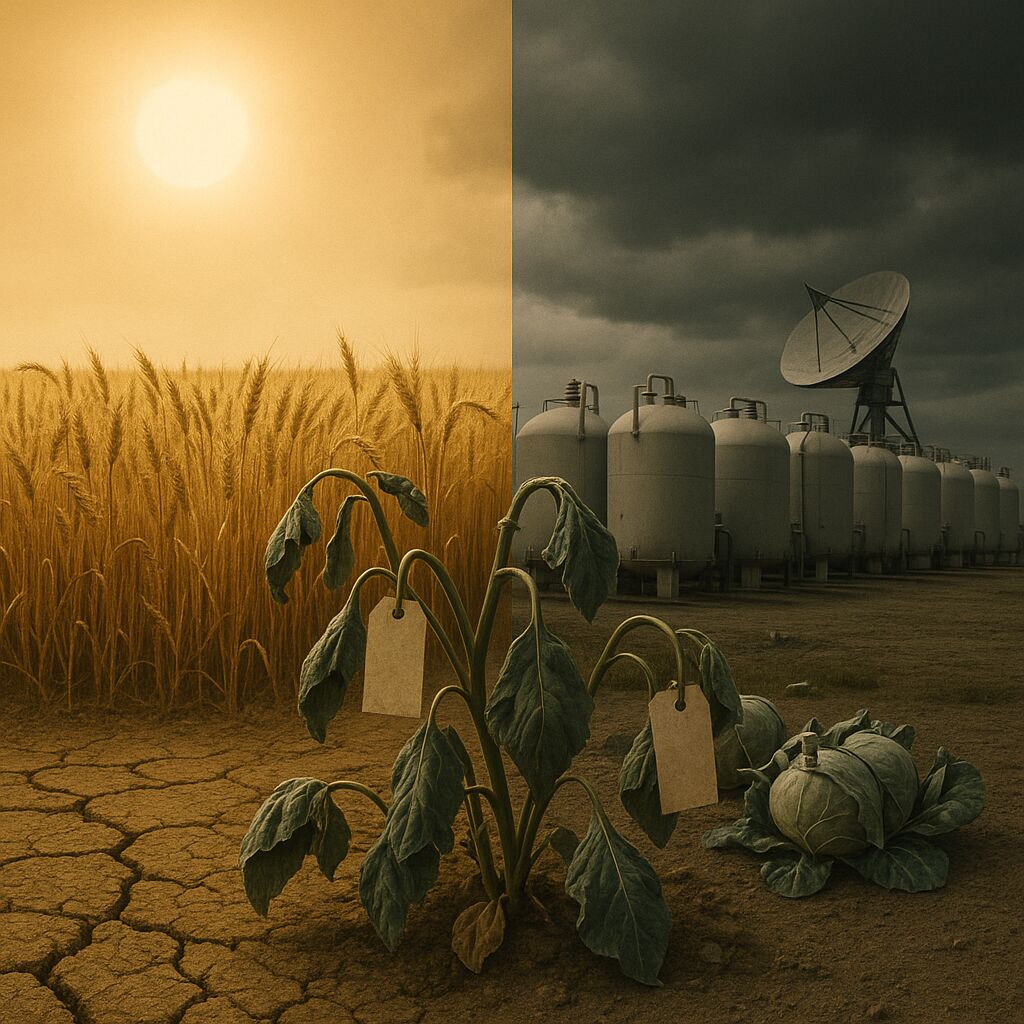
The Food Price Crisis: What's Already Built In
Risk level: High · June 2026
There is a particular kind of futility that comes from watching a mechanism run and knowing you cannot stop it.
The food price crisis is not a risk. It is not a possibility. It is a trajectory that is already running, that was set in motion by decisions made in spring 2026, and that will produce its results through the rest of this year and into 2027. You are not going to see it at the supermarket checkout today. You will see it from August onwards. And once it is running, there is nothing a government can do to stop it. Only to manage who pays the cost.
This post explains why. It is not speculation. It is a description of mechanisms that are already in motion.
The Three-Layer Mechanism
The food price crisis has three distinct causes that are hitting simultaneously. Each one alone would produce significant price pressure. All three together is what makes this a structural event rather than a temporary spike.
Layer 1: The Nitrogen Fertilisers Shock
This is the least visible but most important layer, and it is the one that was set in motion by the closure of the Strait of Hormuz.
Nitrogen fertilisers, specifically urea, ammonium nitrate, and related products, are made from natural gas. The cost of natural gas is the primary driver of nitrogen fertiliser prices. When gas prices rise, fertiliser prices rise. When the supply of fertiliser is disrupted, prices rise further.
The Strait of Hormuz carries roughly one third of the world's traded fertiliser. When it closed on 28 February 2026, the supply of nitrogen fertiliser to the global market was immediately constrained. The World Bank reported a 46% month-on-month rise in urea prices in May 2026. The fertiliser price index stood at 199.71 for May 2026, structurally elevated, not returning to baseline.
The growing season in the Northern Hemisphere is already underway. Farmers in the UK, Europe, North America, and much of Asia are applying fertiliser to their fields right now, in June and July. The price they are paying is significantly higher than it was a year ago. The quantity they can afford to apply is lower.
That decision, made in spring 2026, determines the yield in autumn 2026. Less nitrogen applied to fields means lower crop yields. The harvest that arrives in October and November will be smaller than it would otherwise have been. That smaller harvest, processed and distributed through the supply chain, reaches retail in 2027.
This is not a theoretical chain. It is a mechanical sequence that is currently running. The cause, fertiliser price shock, was set in February and March 2026. The effect, reduced harvest, will arrive in autumn 2026. The consequence, higher food prices at retail, will arrive in 2027.
Layer 2: El Niño
The second layer is weather, and it arrived faster than most models predicted.
The World Meteorological Organization confirmed an 80% chance of a Super El Niño developing between June and August 2026, lasting nine to twelve months. This is not a distant risk. It is a present event. Sea surface temperatures in the equatorial Pacific hit new June records in the first week of June. The Joint Research Centre published an explicit warning on 8 June 2026: agricultural production is threatened by the combination of El Niño and high input prices.
The crop damage is already being reported. Reuters on 4 June 2026 reported dry weather disrupting planting across Asia, Thailand, Vietnam, Indonesia, the Philippines. Australia is forecasting twenty to forty millimetres below-normal rainfall for cropping areas in New South Wales and Queensland over the next three months. East Africa is seeing a mixed picture, with some areas benefiting from early rains but Somalia and southeastern Ethiopia facing delayed rainfall with below-average prospects.
The Super El Niño is expected to peak in late 2026. Its effects on the Northern Hemisphere growing season will be most acute in mid to late summer, precisely the period when the crops planted under fertiliser stress are most vulnerable to heat and water stress.
The combination matters more than either factor alone. Crops that are already working with reduced nitrogen inputs are more vulnerable to heat and water stress. The same plant that might survive a dry spell with adequate nutrition is more likely to fail under the combination of both stresses simultaneously.
Layer 3: Supply Chain Fractures
The third layer is the supply chain disruption that follows from the first two, and it is already beginning to appear in the data.
The Food and Drink Federation has been warning of further food price rises. UK food prices were already 50% above 2019 levels as of early 2026. The April 2026 CPI data showed food price inflation at 3%, down slightly from 3.7% in March, but the direction of travel is still upward, not downward.
Global shipping is disrupted. The closure of Hormuz and the counter-blockade imposed by the United States have reduced the flow of goods through the Gulf. Shipping companies are rerouting around the Cape of Good Hope, adding weeks to transit times and significantly increasing costs. The just-in-time supply chains that modern food distribution depends on are not designed for these kinds of disruptions.
The combination of these three layers, fertiliser shock, El Niño, supply chain disruption, means the 2026 growing season is being hit from three directions at once. This is not a normal price fluctuation. It is a structural reduction in the effective supply of food hitting the global market in 2026 and 2027.
The Two-Year Timeline
The food price crisis is not a single event. It is a two-year process, and it helps to understand the timeline clearly.
2026: The Price Builds
June to August (now): The growing season is underway. Fertilisers are being applied at higher cost and lower quantities than ideal. The price of nitrogen fertiliser is already elevated. Farmers are making decisions right now about how much to apply, and those decisions are determining the yield that will arrive in autumn.
August to September: The first visible food price movements at retail. This is price anticipation. The supply chain is aware that the harvest will be reduced, and prices are adjusted upward before the reduced product even arrives. This is the period when consumers will begin to notice that certain categories are more expensive. This is not yet the peak.
October to November: The harvest arrives. The reduced yield becomes real in the market. Wheat, barley, oilseeds, and other key crops from the Northern Hemisphere growing season begin to enter commercial channels. The volume is lower than it would have been. The price reflects that.
December 2026: The processed and packaged product from the 2026 harvest begins to reach retail. Food price inflation at this point is embedded in the system. The cause was set in spring. The effect is now commercial reality.
2027: The Peak
January to April: The sharpest food price increases arrive. This is when the processed output from the disrupted 2026 growing season reaches retail in its fullest volume. The food price peak in spring and summer 2027 is the consequence that is already structurally embedded. It cannot be stopped by any policy decision made in 2026 or 2027. Only the distribution of its costs can be managed.
Spring and summer 2027: The famine signal becomes undeniable in the most exposed countries. Sub-Saharan Africa, parts of South Asia, and food-import-dependent Gulf states will face the most acute pressure. The death toll from hunger and malnutrition will be significant and measurable. In the UK, the consequence will be visible as the highest grocery bills in living memory.
The 2027 growing season: The question of whether farmers can access fertiliser at viable prices for the 2027 season becomes critical. If the fertiliser price shock persists, the 2027 harvest is also at risk. The food system does not simply snap back when the crisis ends.
Why Government Cannot Stop This
The "Ideal UK Government Response" post described what a government optimising for public welfare would do. The honest answer is that even the ideal government would struggle to prevent the food price peak. Here is why.
The mechanism is already running. The cause was set in February and March 2026. The effect is the 2026 harvest. That harvest is either sufficient or it is not. Policy decisions made in June, July, or August 2026 cannot increase the amount of nitrogen that was applied to fields in April and May. They can only affect who bears the cost of the shortage.
The global market is the mechanism. The UK does not control global fertiliser prices or global food prices. It is a price-taker. When the global price of wheat rises because the global supply is reduced, the UK price rises regardless of what the Bank of England does with interest rates or what the Chancellor announces in the budget.
Subsidies are a transfer, not a solution. A fertiliser subsidy for UK farmers helps UK farmers. It does not increase the global supply of nitrogen fertiliser. If the global supply is constrained and the global price is elevated, the subsidy transfers money from the government, ultimately the taxpayer, to the fertiliser producers. The price to the farmer may fall slightly. The price to the consumer, through the food chain, remains elevated.
Strategic reserves would have helped but were not built. The ideal response would have included building strategic food and fertiliser reserves in 2025, before the crisis. That did not happen. You cannot build a reserve after the shortage has already started.
The distributional problem is the real problem. What a government can do is decide who pays the cost of the food price peak, whether it falls on farmers, who absorb the fertiliser cost, on food manufacturers, who absorb the input cost, on retailers, who absorb the margin pressure, or on consumers, who pay higher prices. This is a political choice. It is not a technical solution to a supply problem.
The people who will pay most are the people with the least: low-income households, people in food-import-dependent countries, people who spend a high proportion of their income on food. This is not a prediction. It is a description of how price mechanisms work.
What This Means for the UK Specifically
The UK context makes the situation worse in specific ways.
The UK is a net food importer. Domestically grown wheat is important, but the UK also imports significant quantities of food from the EU and beyond. The supply chain disruption from Hormuz and the rerouting of shipping lanes affects import prices directly.
Post-Brexit trade barriers compound the problem. The additional friction from EU-UK trade arrangements since Brexit means that when global prices rise, the UK does not have the same access to the EU single market as a mitigation option. The UK's food supply chains are more exposed to global disruption than they would otherwise be.
The NHS is already under pressure. Food price stress affects nutrition-linked health outcomes. The combination of elevated energy costs in hospitals, food price pressure on households, and the ordinary winter surge in demand creates a compounding pressure on a system that has limited headroom.
The BoE June 18 decision is the near-term variable. If the Bank of England raises rates on 18 June, it will suppress consumer spending at exactly the moment when household budgets are already under pressure from food and energy costs. The right call is to hold, and the consensus expectation is that they will hold. But a hold is the absence of making things worse. It is not a solution.
What Can Be Done
This is not an argument for inaction. It is an argument for the right kind of action, taken at the right time.
Now (June to August 2026): Expand free school meals. Increase direct payment transfers to low-income households. Accelerate planning for winter food support. Do not wait for the data to confirm the scale of the problem in September. By then, the decisions that should have been made in June will be deferred again.
Autumn budget (October/November 2026): Shift the fiscal burden toward wealth and assets. Increase inheritance tax. Apply higher council tax bands to high-value properties. Introduce a temporary windfall tax on energy company profits. The argument is not that this fixes the food supply. It does not. It is that the people who own the resources that are generating the crisis should contribute to managing its costs.
Winter 2026 to 2027: Expand food bank capacity. Prepare targeted nutritional support for households with children. Do not use the food crisis as an excuse to lower food import standards. The temptation to reduce regulatory oversight of the food supply chain in order to manage a short-term shortage is real. Resist it.
Spring 2027: Begin the structural conversation about food security and strategic agricultural capacity. The UK has outsourced its food production resilience along with its energy resilience. The ideal time to start building it back was 2025. The next ideal time is now.
The Bottom Line
The food price crisis is not coming. It is already running. The cause was set in February and March 2026. The effect is the 2026 harvest. The consequence is the food price peak in 2027.
The triple compounding, nitrogen fertiliser shock, El Niño crop damage, supply chain disruption, is hitting the 2026 growing season simultaneously. This is not a normal price fluctuation. It is a structural reduction in the effective global food supply that will produce the highest food prices in living memory by spring 2027.
No policy decision made in June 2026 can prevent this. Only the distribution of its costs can be managed. The question is not whether the food will be more expensive. The question is who pays for it.
This site does not offer financial advice. It offers analysis.
Related: "The Ideal UK Government Response, and Why We Won't Get It" · "The Long Cycle, Part 5: After the End"